evaporite / pegmatite
Boron prospectivityacross Australia, the USA & worldwide.
Evaporitic borate and pegmatitic boron, ranked and explained across the United States and Australia.
-
 ✓
✓ Australia
Ranked targets
-
 ✓
✓ United States
Ranked targets
-
 ·
· Canada
Not modelled
- ✓
Everywhere else
Global model
Ranked targets come with national models in Australia and the United States. Everywhere else, the global model returns the prospectivity map, the geology behind it and a confidence read. Next, the models are retrained on the full record and new sources, such as hyperspectral imagery, before we use them to rank and select ground.
How we rank boron ground
From a country to a decision.
- 01 · Atlas
Know the ground
The geology, structure, recorded deposits, tenure and geochemistry over the ground, on one map with the source of every layer.
See Atlas - 02 · Open Ground
Find ground you can peg
Which ground is open, held or excluded, read from each licensing authority's own register.
See Open Ground - 03 · Prospectivity
Rank it for boron
The ground scored for boron, with the evidence behind it and ranked targets in Australia and the United States. Anywhere else, the global model maps boron.
See Prospectivity - 04 · Spectral
Map the alteration
The alteration minerals and the structures that control them, from satellite: regional to district scale, and camp scale from WorldView-3.
See Spectral - 05 · Due Diligence
Check before committing
Tenure, land access, environment and the real cost to hold and test a boron position.
See Due Diligence -
Talk to us about boron
Partners, investors, publishers and researchers.
The deposit system
The boron system.
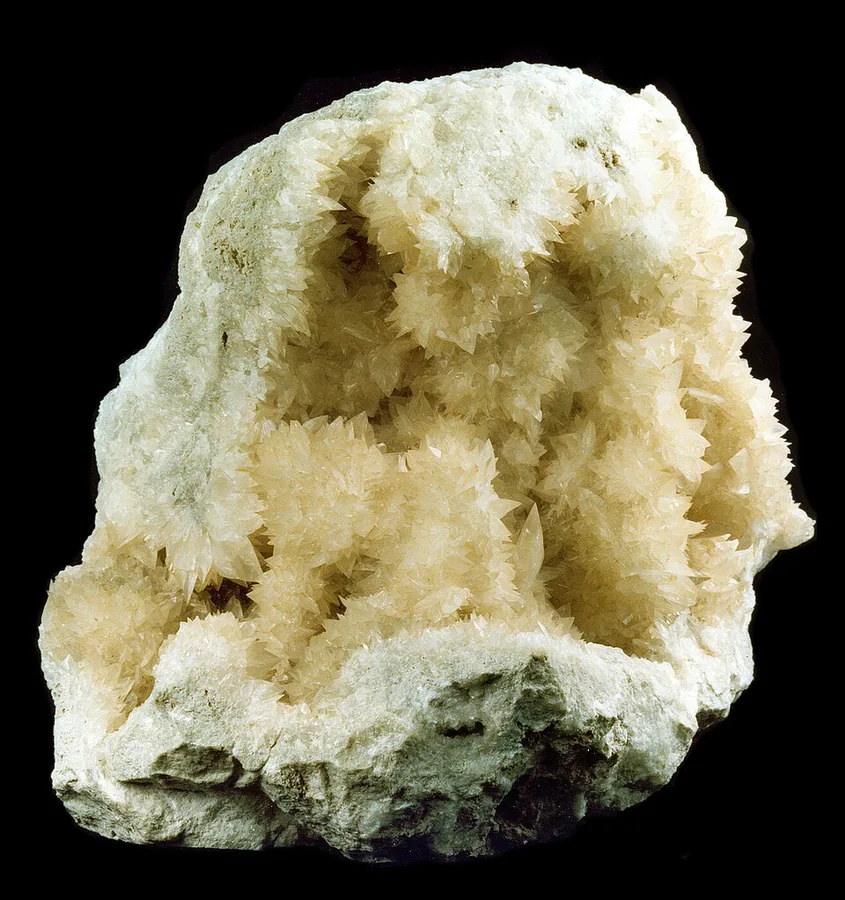
Boron is a light metalloid that almost never occurs as the free element; in nature it is locked into borate minerals, chiefly the sodium borates borax and kernite and the calcium and sodium-calcium borates colemanite and ulexite. Because borates are highly soluble, economic concentrations form only in arid settings.
Read more: the deposit model, why it matters and where it is used +
More on boron
MineDSS models boron through two families: evaporitic borate systems, deposited in closed desert basins, and pegmatitic systems, where boron is carried in tourmaline within highly evolved granitic bodies. Each leaves a mappable footprint: evaporite-bearing lacustrine sequences or altered, veined pegmatite margins, distinctive geophysical responses and a co-located multi-element geochemical halo. That is exactly the pattern a prospectivity model is built to read across large, partly covered terrains.
The deposit model
Evaporitic borate deposits form in impermeable, internally drained basins in arid climates, where volcanic and geothermal activity supplies boron-rich waters that pond in playa lakes and concentrate through evaporation. As the brine matures, a zoned borate assemblage precipitates, with sodium borates such as borax and kernite passing outward into calcium-bearing colemanite and ulexite, interbedded with clays and other evaporites. Pegmatitic systems concentrate boron along the volatile-rich margins of fractionated granitic intrusions, where it crystallises as tourmaline alongside other incompatible elements.
Why it matters
Boron is a strategic industrial material and appears on critical-minerals lists in several jurisdictions, reflecting both its breadth of use and the concentration of its supply. A large share of world borate production and reserves sits with a small number of producers, led by Turkey and the United States, so security of supply is a live concern for downstream manufacturers and governments alike. Interest has sharpened further because boron is essential to neodymium-iron-boron permanent magnets, which drive electric-vehicle motors and wind-turbine generators, and to a range of defence and high-technology applications. Transparent, defensible targeting of prospective ground therefore supports secure, diversified supply for both enterprise and government stakeholders.
Where it's used
The largest uses of boron are in glass and ceramics: borosilicate glass, valued for its resistance to thermal shock, and boron-bearing fibreglass and glass-wool insulation, along with ceramic glazes and enamels. Borates are also central to detergents and bleaches, to agriculture as an essential micronutrient in fertilisers, and to flame retardants and wood preservatives. In high-technology and defence sectors, boron enables neodymium-iron-boron magnets, extremely hard boron carbide for abrasives and armour, and, through its strong neutron absorption, control and shielding materials in nuclear reactors. This breadth across construction, agriculture, clean energy and defence underpins steady, strategically significant demand.
Questions
Boron: common questions.
Which boron deposit types does MineDSS model? +
MineDSS models two families: evaporitic borate systems and pegmatitic boron systems. Evaporitic deposits form in closed, arid desert basins where boron-rich volcanic and geothermal waters concentrate by evaporation, precipitating a zoned assemblage of sodium borates such as borax and kernite and calcium borates such as colemanite and ulexite. Pegmatitic systems carry boron in tourmaline along the volatile-rich margins of highly fractionated granitic intrusions. Both leave a distinct footprint (evaporite-bearing lacustrine sequences or altered pegmatite margins with a co-located geochemical halo), which is the pattern the model is built to read. It does not attempt to represent unrelated deposit styles.
How is the model tested, and where can I run boron? +
Every MineDSS model is tested before it is served: we withhold whole blocks of ground, rebuild the model without them, and check that it still ranks the anomalous samples there above background, with test ground kept spatially separate. A model that does not pass our release gates is not used, for any mineral, in any country. National models for boron run in Australia and the United States, with ranked targets. Anywhere else in the world, the global model returns the prospectivity map, the geology behind it and a confidence read. Skill is model-level, never a specific site's measured accuracy, and never a discovery or JORC / NI 43-101 resource claim.
Which pathfinder elements track boron? +
The classic pathfinders are lithium, arsenic, antimony, strontium, tin and beryllium, with lithium, arsenic and antimony leading. Lithium co-concentrates with boron in evaporated continental brines, arsenic and antimony trace the geothermal and hot-spring input that feeds borate basins, strontium follows the calcium-borate and evaporite chemistry, and tin and beryllium mark the evolved pegmatitic setting where boron crystallises as tourmaline. These elements are part of the geochemical record our models learn from. In a run on any piece of ground, the map itself is read from geology and rock age, gravity and magnetics, radiometrics, terrain, satellite radar and spectral alteration, so it covers ground that has never been sampled.
Does a high MineDSS score mean a deposit or a resource estimate? +
No. A high score means its evidence closely matches ground where samples assay anomalously high for the target mineral, and it merits closer exploration attention. It is not a discovery, not a JORC or NI 43-101 resource or reserve estimate, and not drilling or investment advice. MineDSS ranks prospectivity to help prioritise where to look; confirming whether economic borate or boron mineralisation is present, and in what quantity and grade, still requires field programmes, drilling and independent assessment by qualified professionals.
-
Partners
Exploration and mining companies interested in working with us.
-
Investors
The record, the models and the ground they point to.
-
Publishers and researchers
Geological surveys, universities and programmes whose work the record is built on.
MineDSS ranks prospectivity to help you decide where to explore next. It is not a discovery, not a JORC or NI 43-101 resource or reserve estimate, and not drilling or investment advice.