evolved granite / peralkaline
Hafnium prospectivityacross Australia, the USA, Canada & worldwide.
Evolved-granite, peralkaline and alkaline-complex hafnium, ranked and explained across Australia, the United States and Canada.
-
 ✓
✓ Australia
Ranked targets
-
 ✓
✓ United States
Ranked targets
-
 ✓
✓ Canada
Ranked targets
- ✓
Everywhere else
Global model
Ranked targets come with national models in Australia, the United States and Canada. Everywhere else, the global model returns the prospectivity map, the geology behind it and a confidence read. Next, the models are retrained on the full record and new sources, such as hyperspectral imagery, before we use them to rank and select ground.
How we rank hafnium ground
From a country to a decision.
- 01 · Atlas
Know the ground
The geology, structure, recorded deposits, tenure and geochemistry over the ground, on one map with the source of every layer.
See Atlas - 02 · Open Ground
Find ground you can peg
Which ground is open, held or excluded, read from each licensing authority's own register.
See Open Ground - 03 · Prospectivity
Rank it for hafnium
The ground scored for hafnium, with the evidence behind it and ranked targets in Australia, the United States and Canada. Anywhere else, the global model maps hafnium.
See Prospectivity - 04 · Spectral
Map the alteration
The alteration minerals and the structures that control them, from satellite: regional to district scale, and camp scale from WorldView-3.
See Spectral - 05 · Due Diligence
Check before committing
Tenure, land access, environment and the real cost to hold and test a hafnium position.
See Due Diligence -
Talk to us about hafnium
Partners, investors, publishers and researchers.
The deposit system
The hafnium system.
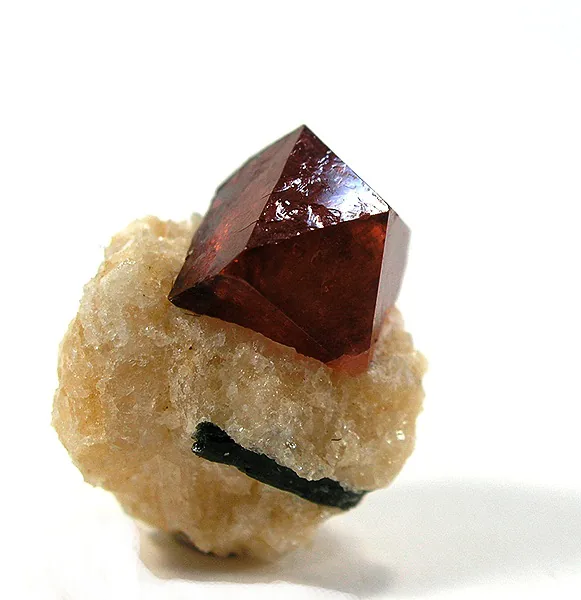
Hafnium is a lustrous, corrosion-resistant refractory metal and the near-chemical twin of zirconium: the two share almost identical ionic radii, so hafnium substitutes for zirconium in the same minerals and is stubbornly difficult to separate from it. It forms no ore mineral of its own.
Read more: the deposit model, why it matters and where it is used +
More on hafnium
Instead it is carried in zircon, a zirconium silicate, and, less commonly, in baddeleyite, a zirconium oxide, and it is recovered as a by-product of zirconium refining. MineDSS models the settings whose zircon and baddeleyite carry the richest hafnium: evolved felsic, peralkaline and alkaline-complex igneous systems. As granitic magma differentiates, hafnium concentrates in late-crystallising zircon, so the most fractionated and alkali-enriched intrusions leave the strongest signal: altered, high-field-strength-enriched rocks with a distinctive radiometric and multi-element geochemical footprint that a prospectivity model is built to read.
The deposit model
Hafnium has no dedicated ore-forming process; it rides with zirconium in accessory zircon and baddeleyite, and its tenor rises as felsic magmas evolve. Highly fractionated felsic granites (rare-metal leucogranites and their greisens) reach the extreme differentiation that drives the zirconium-to-hafnium ratio down and co-enriches tin, tungsten, niobium, tantalum and beryllium. Peralkaline granites and syenites crystallise abundant zircon and other high-field-strength phases from alkali-rich melts saturated in niobium, tantalum, thorium, uranium and the rare earths. Alkaline igneous complexes host baddeleyite and zircon in ring intrusions and their associated syenites. Each leaves a mappable footprint: radiometric responses from thorium, uranium and potassium, high-field-strength geochemical halos, and characteristic alteration.
Why it matters
Hafnium is classed as a critical mineral in several major economies, and its strategic weight comes as much from how it is supplied as from what it does. It cannot be mined on its own: essentially all primary hafnium is separated from zirconium during refining, by a small number of specialist producers, and the nuclear- and semiconductor-grade purity that its highest-value uses demand narrows effective supply further. Demand is projected to climb as aerospace, nuclear power and advanced computing expand, while output remains tethered to the zirconium and nuclear-grade zirconium markets. Because the metal is a by-product with concentrated processing, transparent, defensible targeting of the evolved and peralkaline systems that carry the richest hafnium-bearing zircon has real value for explorers and for governments working to secure and diversify supply.
Where it's used
Hafnium's standout property is an exceptionally high thermal-neutron-capture cross-section paired with corrosion resistance and mechanical stability, which makes it a preferred material for nuclear reactor control rods, including in naval propulsion. Its very high melting point suits it to nickel-based superalloys, where small hafnium additions improve high-temperature strength and oxidation resistance in the turbine blades and vanes of jet engines and industrial gas turbines. In microelectronics, hafnium oxide serves as a high-permittivity gate dielectric in advanced logic chips. Hafnium carbide and diboride are among the most refractory ceramics known, used in rocket nozzles, hypersonic leading edges and plasma-cutting electrodes.
Questions
Hafnium: common questions.
Which hafnium deposit types does MineDSS model? +
MineDSS models three igneous settings, all of which host hafnium in zircon and baddeleyite: highly fractionated felsic granites, peralkaline granites and syenites, and alkaline igneous complexes. Hafnium forms no ore mineral of its own, so the model does not target a hafnium mineral directly; it ranks the fertile, evolved and alkali-rich intrusions whose accessory zircon carries the highest hafnium tenor. Fractionated granites reach the extreme differentiation that lowers the zirconium-to-hafnium ratio and co-enriches tin, tungsten, niobium and tantalum, while peralkaline and alkaline systems crystallise abundant high-field-strength phases. The model does not attempt to represent unrelated deposit styles.
How is the model tested, and where can I run hafnium? +
Every MineDSS model is tested before it is served: we withhold whole blocks of ground, rebuild the model without them, and check that it still ranks the anomalous samples there above background, with test ground kept spatially separate. A model that does not pass our release gates is not used, for any mineral, in any country. National models for hafnium run in Australia, the United States and Canada, with ranked targets. Anywhere else in the world, the global model returns the prospectivity map, the geology behind it and a confidence read. Skill is model-level, never a specific site's measured accuracy, and never a discovery or JORC / NI 43-101 resource claim.
Which pathfinder elements track hafnium? +
The classic pathfinders are niobium, tantalum, thorium, uranium, tin, tungsten and beryllium, with niobium, tantalum and thorium leading. Because hafnium hides in zircon rather than forming its own mineral, these elements serve as fertility indicators: niobium and tantalum mark the high-field-strength enrichment of evolved and peralkaline melts, thorium and uranium track the radioelement-rich accessory minerals of those systems, and tin, tungsten and beryllium reflect the greisen and pegmatite associations of highly fractionated granites. These elements are part of the geochemical record our models learn from. In a run on any piece of ground, the map itself is read from geology and rock age, gravity and magnetics, radiometrics, terrain, satellite radar and spectral alteration, so it covers ground that has never been sampled.
Does a high MineDSS score mean a deposit or a resource estimate? +
No. A high score means its evidence closely matches ground where samples assay anomalously high for the target mineral, and it merits closer exploration attention. It is not a discovery, not a JORC or NI 43-101 resource or reserve estimate, and not drilling or investment advice. MineDSS ranks prospectivity to help prioritise where to look; confirming whether economic hafnium-bearing mineralisation is present, and in what quantity and grade, still requires field programmes, drilling and independent assessment by qualified professionals. Because hafnium is recovered as a by-product of zirconium, its economics also depend on the host zircon or baddeleyite resource, not on hafnium alone.
-
Partners
Exploration and mining companies interested in working with us.
-
Investors
The record, the models and the ground they point to.
-
Publishers and researchers
Geological surveys, universities and programmes whose work the record is built on.
MineDSS ranks prospectivity to help you decide where to explore next. It is not a discovery, not a JORC or NI 43-101 resource or reserve estimate, and not drilling or investment advice.