greisen / vein / placer
Tin prospectivityacross Australia, the USA, Canada & worldwide.
Greisen, vein and placer tin from evolved granites, ranked and explained across Australia, the United States and Canada.
-
 ✓
✓ Australia
Ranked targets
-
 ✓
✓ United States
Ranked targets
-
 ✓
✓ Canada
Ranked targets
- ✓
Everywhere else
Global model
Ranked targets come with national models in Australia, the United States and Canada. Everywhere else, the global model returns the prospectivity map, the geology behind it and a confidence read. Next, the models are retrained on the full record and new sources, such as hyperspectral imagery, before we use them to rank and select ground.
How we rank tin ground
From a country to a decision.
- 01 · Atlas
Know the ground
The geology, structure, recorded deposits, tenure and geochemistry over the ground, on one map with the source of every layer.
See Atlas - 02 · Open Ground
Find ground you can peg
Which ground is open, held or excluded, read from each licensing authority's own register.
See Open Ground - 03 · Prospectivity
Rank it for tin
The ground scored for tin, with the evidence behind it and ranked targets in Australia, the United States and Canada. Anywhere else, the global model maps tin.
See Prospectivity - 04 · Spectral
Map the alteration
The alteration minerals and the structures that control them, from satellite: regional to district scale, and camp scale from WorldView-3.
See Spectral - 05 · Due Diligence
Check before committing
Tenure, land access, environment and the real cost to hold and test a tin position.
See Due Diligence -
Talk to us about tin
Partners, investors, publishers and researchers.
The deposit system
The tin system.
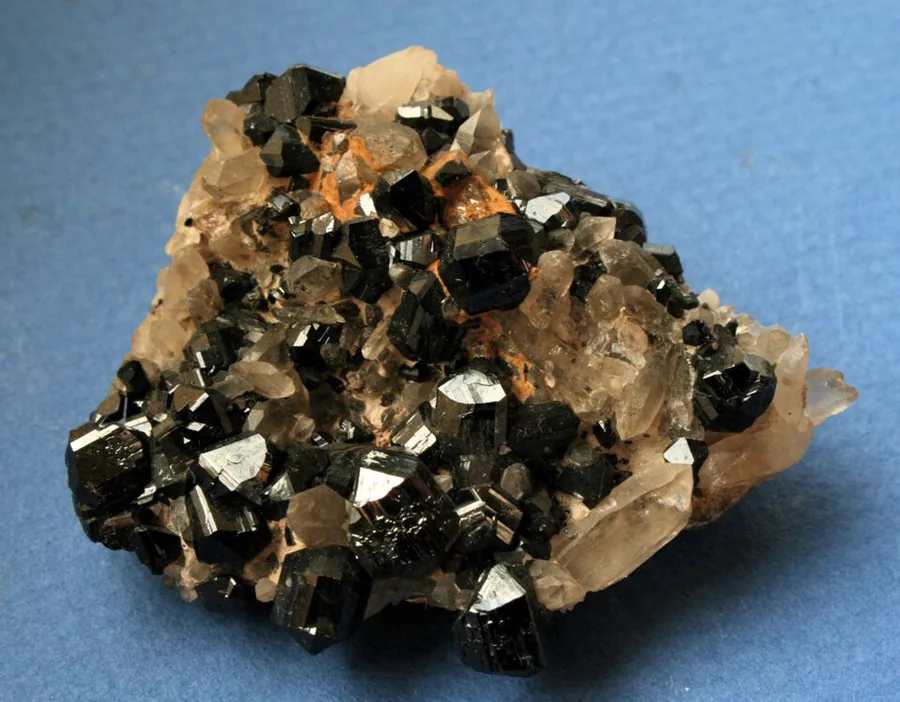
Tin is a soft, corrosion-resistant metal whose economic concentrations are won almost entirely from a single ore mineral, cassiterite, a dense and durable tin oxide, with minor contributions from the sulphide stannite. It is recovered both from hard-rock lodes and from the placer deposits those lodes shed.
Read more: the deposit model, why it matters and where it is used +
More on tin
MineDSS models tin through three systems tied to evolved granites: greisen, vein and placer. Each traces back to a highly fractionated granite that concentrated tin in its uppermost cupola, then vented tin-bearing fluids into surrounding fractures and alteration zones. The mappable footprint is that fertile granite architecture and its aureole: greisenised and veined intrusive rock, a distinctive incompatible-element geochemical halo, and downstream concentrations of resistant cassiterite. That is exactly the pattern a model is built to detect across large, partly covered terrains.
The deposit model
Tin systems are governed by extreme magmatic fractionation followed by hydrothermal venting. The parent granites are evolved, reduced, peraluminous and volatile-rich, becoming enriched in incompatible elements as they crystallise. Greisen deposits form where late fluids alter the granite cupola to a quartz-muscovite-topaz-fluorite assemblage, precipitating disseminated and veinlet cassiterite, often accompanied by wolframite. Vein and lode systems concentrate the same quartz-cassiterite mineralisation along sheeted fractures, faults and greisen selvages on and around the pluton margin. Placer deposits form where weathering liberates cassiterite, whose high density, hardness and chemical resistance let it survive transport and concentrate in eluvial and alluvial settings downslope and downstream.
Why it matters
Tin is a strategic industrial metal and appears on critical-minerals lists in the United States, the European Union and other economies, because it is the metal that joins modern electronics. It is essential to the solder that connects virtually every circuit board, so tin supply underpins computing, telecommunications, defence electronics and the electrification of transport and power. Production is geographically concentrated in Southeast Asia, the Andes and Central Africa, and several major consumers, including the United States, have long relied on imports and recycling rather than domestic primary supply. That concentration, together with recent efforts to rebuild secure and allied supply chains, gives transparent, defensible targeting of prospective ground real weight for both explorers and the governments that permit them.
Where it's used
The single largest use of tin is solder, above all the lead-free solders that join components on printed circuit boards, which makes it a quiet enabler of the entire electronics industry. Tinplate (steel thinly coated with tin) provides the corrosion-resistant, food-safe packaging behind cans and containers. Tin chemicals stabilise PVC and serve as catalysts and pigments, while tin alloys deliver bronze, pewter and the babbitt metals used in bearings. Molten tin forms the flat bath on which float glass is made, and tin oxides provide the transparent conductive coatings behind displays and touchscreens. Tin-based anodes are also an active area of research for lithium-ion and sodium-ion batteries, extending the metal's reach into energy storage.
Questions
Tin: common questions.
Which tin deposit types does MineDSS model? +
MineDSS models three systems tied to evolved granites: greisen, vein and placer. Greisen deposits host cassiterite in altered granite cupolas, where quartz-muscovite-topaz-fluorite alteration and disseminated tin oxide, often with wolframite, mark the top of a fertile pluton. Vein and lode systems carry the same quartz-cassiterite mineralisation along sheeted fractures and granite margins. Placer deposits form where weathering frees dense, durable cassiterite that concentrates in eluvial and alluvial ground downstream. The model does not attempt to represent unrelated deposit styles; it ranks ground by how closely its evidence matches ground where samples assay anomalously high for the target mineral.
How is the model tested, and where can I run tin? +
Every MineDSS model is tested before it is served: we withhold whole blocks of ground, rebuild the model without them, and check that it still ranks the anomalous samples there above background, with test ground kept spatially separate. A model that does not pass our release gates is not used, for any mineral, in any country. National models for tin run in Australia, the United States and Canada, with ranked targets. Anywhere else in the world, the global model returns the prospectivity map, the geology behind it and a confidence read. Skill is model-level, never a specific site's measured accuracy, and never a discovery or JORC / NI 43-101 resource claim.
Which pathfinder elements track tin? +
The classic pathfinders are tungsten, lithium, rubidium, caesium, beryllium, niobium and bismuth, with tungsten, lithium and rubidium leading. Lithium, rubidium, caesium, beryllium and niobium trace the extreme fractionation of a fertile, highly evolved granite, while tungsten and bismuth accompany cassiterite in greisen and vein sulphide assemblages. These elements are part of the geochemical record our models learn from. In a run on any piece of ground, the map itself is read from geology and rock age, gravity and magnetics, radiometrics, terrain, satellite radar and spectral alteration, so it covers ground that has never been sampled.
Does a high MineDSS score mean a deposit or a resource estimate? +
No. A high score means its evidence closely matches ground where samples assay anomalously high for the target mineral, and it merits closer exploration attention. It is not a discovery, not a JORC or NI 43-101 resource or reserve estimate, and not drilling or investment advice. MineDSS ranks prospectivity to help prioritise where to look; confirming whether tin is present, and in what quantity and grade, still requires field programmes, drilling and independent assessment by qualified professionals.
-
Partners
Exploration and mining companies interested in working with us.
-
Investors
The record, the models and the ground they point to.
-
Publishers and researchers
Geological surveys, universities and programmes whose work the record is built on.
MineDSS ranks prospectivity to help you decide where to explore next. It is not a discovery, not a JORC or NI 43-101 resource or reserve estimate, and not drilling or investment advice.