skarn / vein / greisen
Tungsten prospectivityacross Australia, the USA, Canada & worldwide.
Skarn, vein and greisen tungsten, ranked and explained across Australia, the United States and Canada.
-
 ✓
✓ Australia
Ranked targets
-
 ✓
✓ United States
Ranked targets
-
 ✓
✓ Canada
Ranked targets
- ✓
Everywhere else
Global model
Ranked targets come with national models in Australia, the United States and Canada. Everywhere else, the global model returns the prospectivity map, the geology behind it and a confidence read. Next, the models are retrained on the full record and new sources, such as hyperspectral imagery, before we use them to rank and select ground.
How we rank tungsten ground
From a country to a decision.
- 01 · Atlas
Know the ground
The geology, structure, recorded deposits, tenure and geochemistry over the ground, on one map with the source of every layer.
See Atlas - 02 · Open Ground
Find ground you can peg
Which ground is open, held or excluded, read from each licensing authority's own register.
See Open Ground - 03 · Prospectivity
Rank it for tungsten
The ground scored for tungsten, with the evidence behind it and ranked targets in Australia, the United States and Canada. Anywhere else, the global model maps tungsten.
See Prospectivity - 04 · Spectral
Map the alteration
The alteration minerals and the structures that control them, from satellite: regional to district scale, and camp scale from WorldView-3.
See Spectral - 05 · Due Diligence
Check before committing
Tenure, land access, environment and the real cost to hold and test a tungsten position.
See Due Diligence -
Talk to us about tungsten
Partners, investors, publishers and researchers.
The deposit system
The tungsten system.
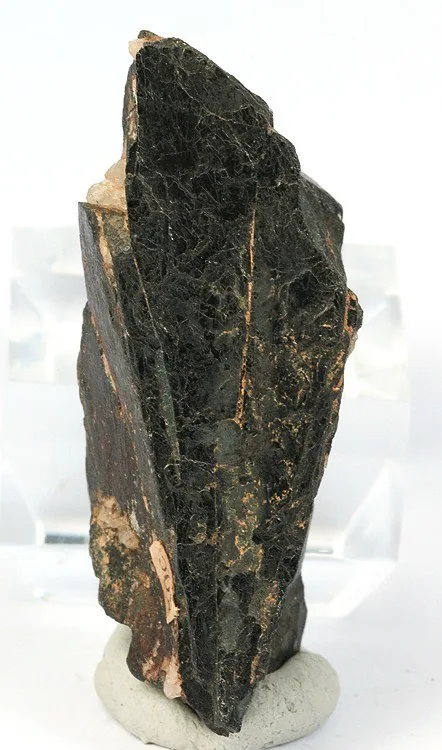
Tungsten is a refractory transition metal, chemical symbol W after its historic name wolfram, prized for the highest melting point of any metal together with exceptional density, hardness and heat resistance. In nature it is won almost entirely from two ore minerals: scheelite, a calcium tungstate, and the wolframite series of iron-manganese tungstates.
Read more: the deposit model, why it matters and where it is used +
More on tungsten
Both crystallise from volatile-rich fluids expelled by cooling granitic intrusions, and MineDSS models tungsten through three deposit systems: skarn, vein and greisen. Each is tied to felsic intrusions, hydrothermal alteration and structurally focused mineralisation, and each leaves a mappable footprint: altered and veined intrusive and carbonate rocks, characteristic geophysical responses over concealed granites, and a distinctive granophile multi-element geochemical halo that a prospectivity model is built to read across large, partly covered terrains.
The deposit model
All three systems descend from the same source: fractionated, volatile-rich granitic magmas that expel tungsten-bearing hydrothermal fluids as they cool. Skarn deposits form where those fluids invade carbonate country rock beside an intrusion, replacing it with coarse calc-silicate assemblages in which scheelite is deposited, commonly in the classic reduced tungsten skarns whose retrograde alteration adds fluorine, silica, tin and bismuth. Vein systems concentrate wolframite in quartz veins that radiate from granite cupolas, from centimetre-scale sheeted swarms to metre-wide structures traceable for hundreds of metres. Greisen systems represent the altered, muscovite-quartz-topaz tops of late-stage granites, carrying wolframite and scheelite alongside cassiterite.
Why it matters
Tungsten is a strategic industrial metal and appears on the critical-minerals lists of several major economies, reflecting both its irreplaceable industrial roles and a concentrated supply base. Its combination of extreme hardness, density and thermal stability underpins cutting tools, defence hardware and semiconductor manufacturing, where viable substitutes are scarce. Supply is unusually concentrated: a single country accounts for roughly four-fifths of mined output, and recent export-licensing measures have tightened an already narrow pipeline, sharpening interest in diversified primary sources. Because lead times from discovery to mine are long and prospective ground is easily overlooked beneath cover, transparent and defensible targeting carries real strategic weight for both explorers and the governments that permit and rely on secure supply.
Where it's used
The dominant use of tungsten is cemented tungsten carbide, an extraordinarily hard composite that accounts for most consumption and equips the cutting, drilling and wear-resistant tools of the metalworking, mining, construction and oil-and-gas industries. Tungsten is also a key alloying element in high-speed and tool steels and in superalloys, where it preserves strength and cutting edge at high temperature. Its very high density suits kinetic-energy penetrators, armour and radiation shielding, as well as balancing and vibration-damping weights. The metal's unmatched melting point long made it the material of choice for lamp filaments and electrodes, and it still serves electrical contacts, heating elements, catalysts and speciality pigments.
Questions
Tungsten: common questions.
Which tungsten deposit types does MineDSS model? +
MineDSS models three deposit systems: skarn, vein and greisen tungsten. Skarn deposits host scheelite in calc-silicate rock where granitic fluids replace carbonate country rock, vein systems carry wolframite in quartz veins radiating from granite cupolas, and greisen systems concentrate wolframite and scheelite in the muscovite-quartz-topaz altered tops of late-stage granites. All three descend from the same fractionated, volatile-rich felsic magmas, which is the intrusion-related footprint the model is built to read. The model does not attempt to represent unrelated deposit styles; it ranks ground by how closely its evidence matches ground where samples assay anomalously high for the target mineral.
How is the model tested, and where can I run tungsten? +
Every MineDSS model is tested before it is served: we withhold whole blocks of ground, rebuild the model without them, and check that it still ranks the anomalous samples there above background, with test ground kept spatially separate. A model that does not pass our release gates is not used, for any mineral, in any country. National models for tungsten run in Australia, the United States and Canada, with ranked targets. Anywhere else in the world, the global model returns the prospectivity map, the geology behind it and a confidence read. Skill is model-level, never a specific site's measured accuracy, and never a discovery or JORC / NI 43-101 resource claim.
Which pathfinder elements track tungsten? +
The classic pathfinders are tin, bismuth, molybdenum, arsenic, beryllium, lithium and copper, with tin, bismuth and molybdenum leading for skarn, vein and greisen systems. These elements reflect the granophile, greisen and sulphide associations typical of scheelite and wolframite mineralisation, tracing the fractionated granitic fluids from which tungsten precipitates. These elements are part of the geochemical record our models learn from. In a run on any piece of ground, the map itself is read from geology and rock age, gravity and magnetics, radiometrics, terrain, satellite radar and spectral alteration, so it covers ground that has never been sampled.
Does a high MineDSS score mean a deposit or a resource estimate? +
No. A high score means its evidence closely matches ground where samples assay anomalously high for the target mineral, and it merits closer exploration attention. It is not a discovery, not a JORC or NI 43-101 resource or reserve estimate, and not drilling or investment advice. MineDSS ranks prospectivity to help prioritise where to look; confirming whether tungsten is present, and in what quantity and grade, still requires field programmes, drilling and independent assessment by qualified professionals.
-
Partners
Exploration and mining companies interested in working with us.
-
Investors
The record, the models and the ground they point to.
-
Publishers and researchers
Geological surveys, universities and programmes whose work the record is built on.
MineDSS ranks prospectivity to help you decide where to explore next. It is not a discovery, not a JORC or NI 43-101 resource or reserve estimate, and not drilling or investment advice.