orogenic / intrusion-related
Gold prospectivityacross Australia, the USA, Canada & worldwide.
Orogenic and intrusion-related gold, ranked and explained across Australia, the United States and Canada.
-
 ✓
✓ Australia
Ranked targets
-
 ✓
✓ United States
Ranked targets
-
 ✓
✓ Canada
Ranked targets
- ✓
Everywhere else
Global model
Ranked targets come with national models in Australia, the United States and Canada. Everywhere else, the global model returns the prospectivity map, the geology behind it and a confidence read. Next, the models are retrained on the full record and new sources, such as hyperspectral imagery, before we use them to rank and select ground.
How we rank gold ground
From a country to a decision.
- 01 · Atlas
Know the ground
The geology, structure, recorded deposits, tenure and geochemistry over the ground, on one map with the source of every layer.
See Atlas - 02 · Open Ground
Find ground you can peg
Which ground is open, held or excluded, read from each licensing authority's own register.
See Open Ground - 03 · Prospectivity
Rank it for gold
The ground scored for gold, with the evidence behind it and ranked targets in Australia, the United States and Canada. Anywhere else, the global model maps gold.
See Prospectivity - 04 · Spectral
Map the alteration
The alteration minerals and the structures that control them, from satellite: regional to district scale, and camp scale from WorldView-3.
See Spectral - 05 · Due Diligence
Check before committing
Tenure, land access, environment and the real cost to hold and test a gold position.
See Due Diligence -
Talk to us about gold
Partners, investors, publishers and researchers.
Live examples
See gold on real ground.
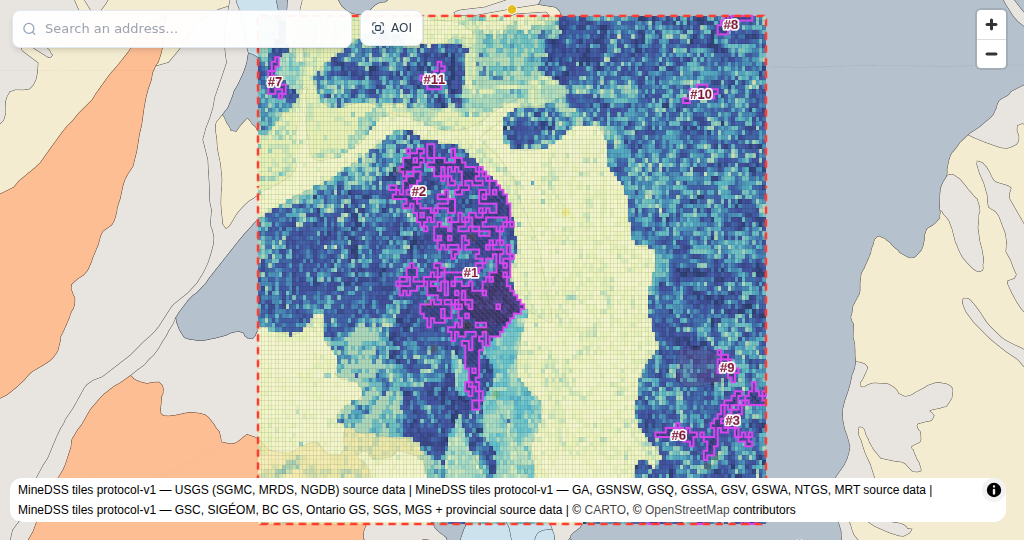
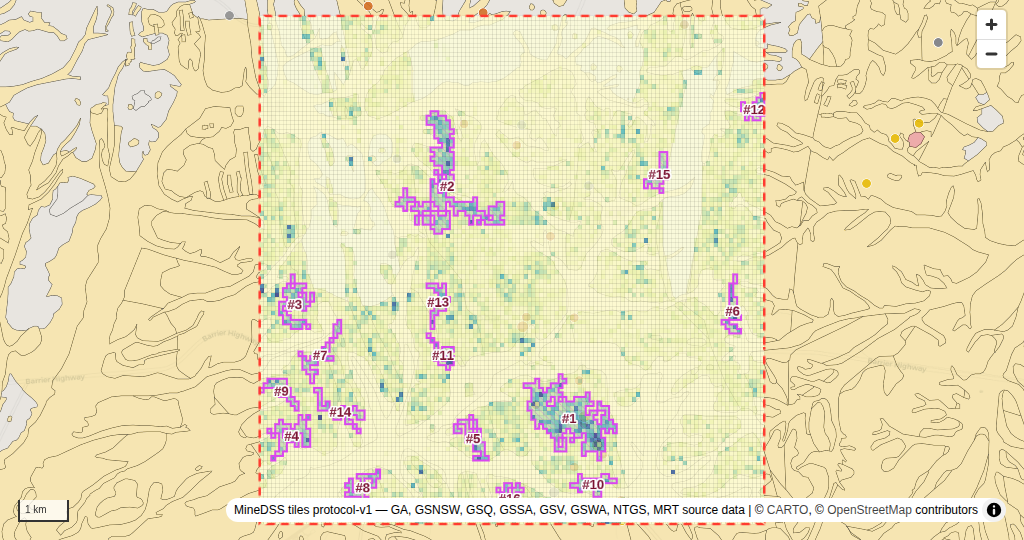
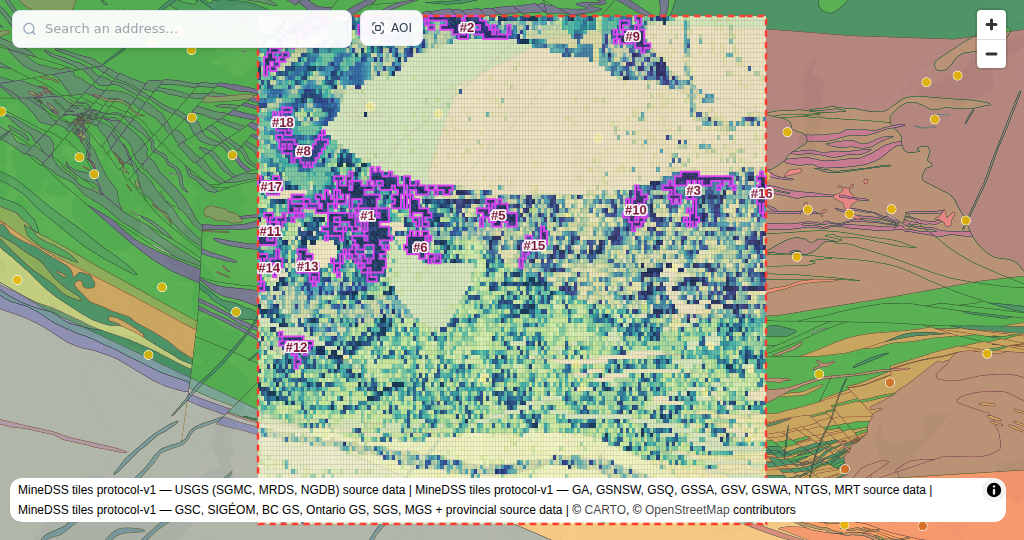
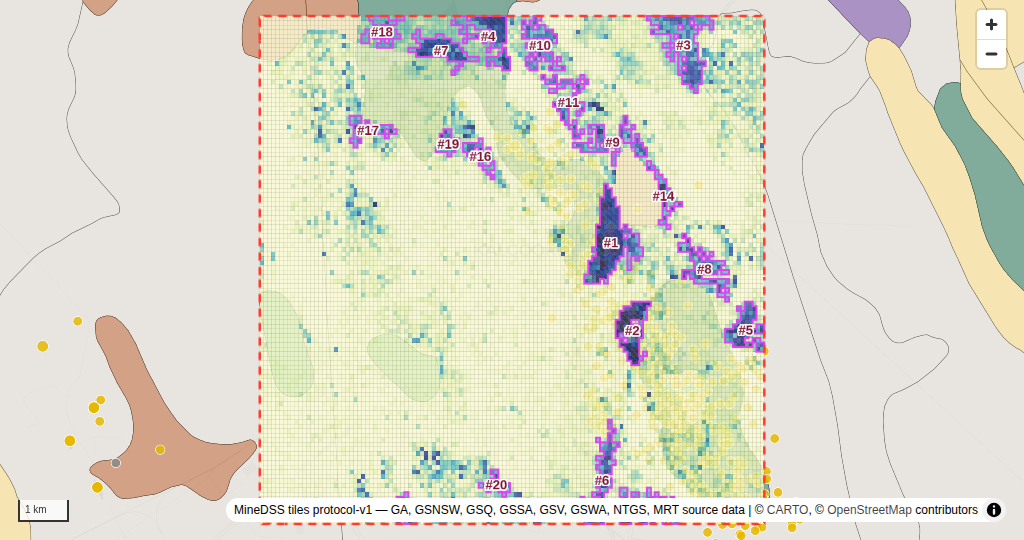
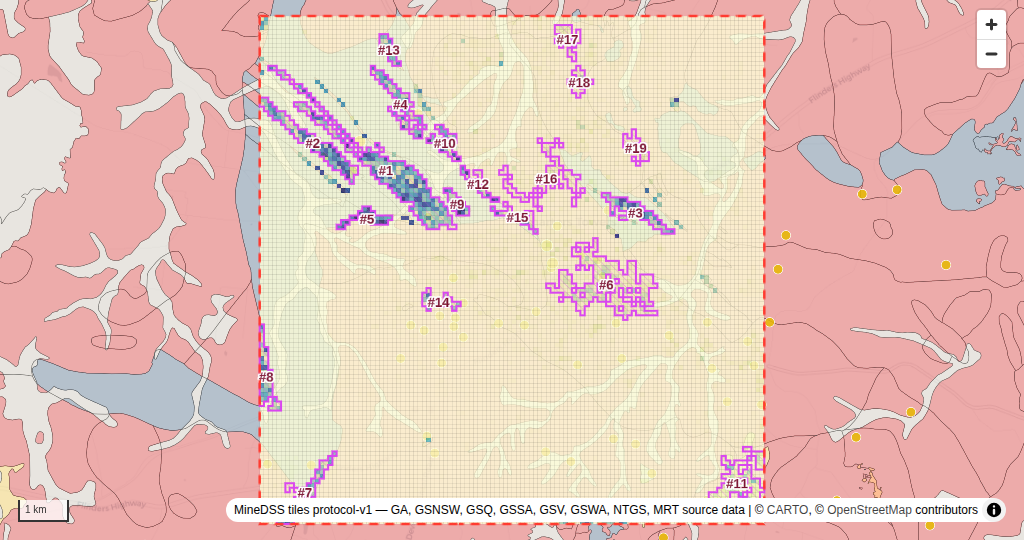
Example runs with the prospectivity map, the reasoning behind each target and the geology beneath it. No login needed.
The deposit system
The gold system.
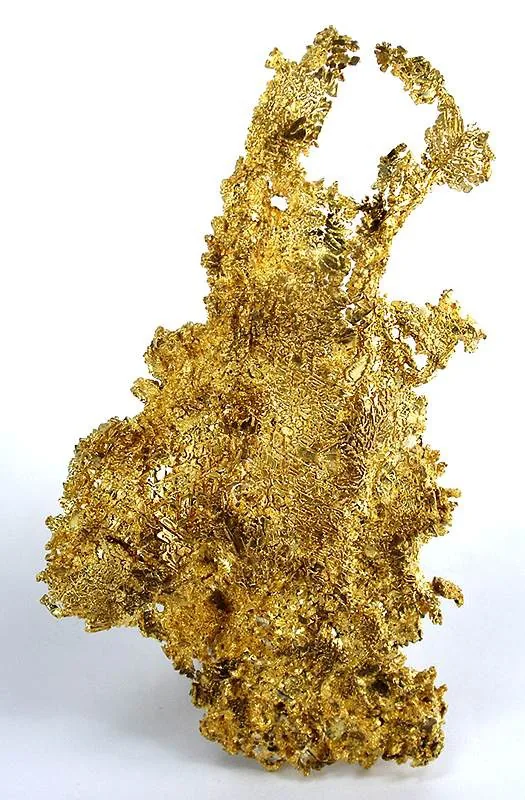
Gold is the archetypal exploration target: high value, globally liquid, and hosted across a wide range of geological settings. MineDSS focuses on the two systems that hold most of the world's hard-rock gold: orogenic (mesothermal) lode gold, deposited where mineralising fluids move along major crustal faults during mountain-building, and intrusion-related gold, sourced from cooling granitic bodies at depth.
Read more: the deposit model, why it matters and where it is used +
More on gold
Both leave a chemical and geophysical footprint far larger than the ore itself, and that footprint is what a prospectivity model learns to read.
The deposit model
Orogenic gold clusters along deep, long-lived fault systems and their splays, typically in deformed greenstone belts and metasedimentary terranes. It is strongly structurally controlled, commonly accompanied by quartz-carbonate veining and sericite-carbonate alteration, with the gold associated with sulphides such as arsenopyrite and pyrite. Intrusion-related systems sit in and around felsic intrusions as sheeted vein arrays with a characteristic metal association.
Why it matters
Gold underpins a large share of global exploration spend and the majority of listed explorers on the ASX and TSX. As a monetary metal held by central banks and investors as a store of value, its demand stays structurally resilient through commodity cycles, which keeps the search for new ounces continuous.
Where it's used
Beyond investment and jewellery, gold's resistance to corrosion and excellent conductivity make it essential in high-reliability electronics (connectors, bonding wire and circuitry) as well as dentistry, medical devices and aerospace components.
Questions
Gold: common questions.
What gold deposit types does MineDSS model? +
Orogenic (mesothermal) lode gold and intrusion-related gold systems: the settings that host most of the world's hard-rock gold. You can open live example runs over the Carlin Trend in Nevada and Val-d'Or in Quebec, with no login needed.
How is the model tested, and where can I run gold? +
Every MineDSS model is tested before it is served: we withhold whole blocks of ground, rebuild the model without them, and check that it still ranks the anomalous samples there above background, with test ground kept spatially separate. A model that does not pass our release gates is not used, for any mineral, in any country. National models for gold run in Australia, the United States and Canada, with ranked targets. Anywhere else in the world, the global model returns the prospectivity map, the geology behind it and a confidence read. Skill is model-level, never a specific site's measured accuracy, and never a discovery or JORC / NI 43-101 resource claim.
What evidence ranks gold ground? +
Six lines of evidence: mapped geology and rock age, gravity and magnetics, radiometrics, terrain, satellite radar and spectral alteration, combined into one explainable score across the ground. The models learn from the geochemical record, including the classic gold pathfinders arsenic, antimony and bismuth, so the map also covers ground that has never been sampled.
-
Partners
Exploration and mining companies interested in working with us.
-
Investors
The record, the models and the ground they point to.
-
Publishers and researchers
Geological surveys, universities and programmes whose work the record is built on.
MineDSS ranks prospectivity to help you decide where to explore next. It is not a discovery, not a JORC or NI 43-101 resource or reserve estimate, and not drilling or investment advice.