epithermal / polymetallic
Tellurium prospectivityacross Australia, the USA, Canada & worldwide.
Epithermal gold–silver and polymetallic tellurium, ranked and explained across Australia, the United States and Canada.
-
 ✓
✓ Australia
Ranked targets
-
 ✓
✓ United States
Ranked targets
-
 ✓
✓ Canada
Ranked targets
- ✓
Everywhere else
Global model
Ranked targets come with national models in Australia, the United States and Canada. Everywhere else, the global model returns the prospectivity map, the geology behind it and a confidence read. Next, the models are retrained on the full record and new sources, such as hyperspectral imagery, before we use them to rank and select ground.
How we rank tellurium ground
From a country to a decision.
- 01 · Atlas
Know the ground
The geology, structure, recorded deposits, tenure and geochemistry over the ground, on one map with the source of every layer.
See Atlas - 02 · Open Ground
Find ground you can peg
Which ground is open, held or excluded, read from each licensing authority's own register.
See Open Ground - 03 · Prospectivity
Rank it for tellurium
The ground scored for tellurium, with the evidence behind it and ranked targets in Australia, the United States and Canada. Anywhere else, the global model maps tellurium.
See Prospectivity - 04 · Spectral
Map the alteration
The alteration minerals and the structures that control them, from satellite: regional to district scale, and camp scale from WorldView-3.
See Spectral - 05 · Due Diligence
Check before committing
Tenure, land access, environment and the real cost to hold and test a tellurium position.
See Due Diligence -
Talk to us about tellurium
Partners, investors, publishers and researchers.
The deposit system
The tellurium system.
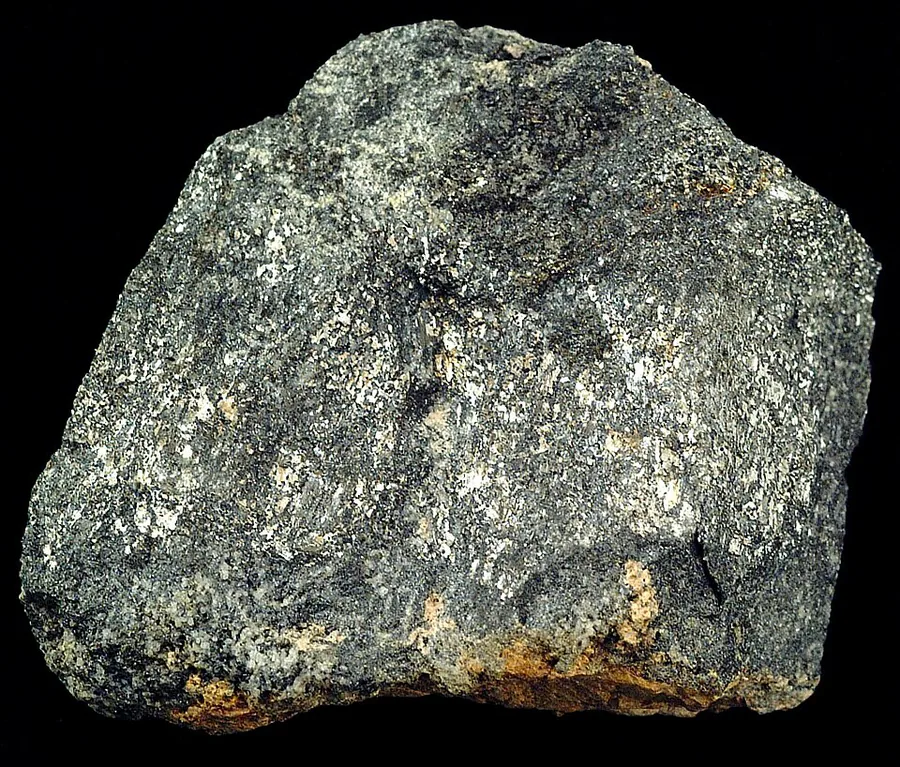
Tellurium is a rare, brittle, silver-white metalloid with a strong geochemical affinity for gold. It seldom forms minerals of its own in bulk; instead it occurs as gold, silver, lead and mercury tellurides (calaverite, sylvanite, petzite, hessite, coloradoite and altaite) and as native tellurium, typically hosted within precious-metal veins.
Read more: the deposit model, why it matters and where it is used +
More on tellurium
Because economic concentrations are scarce, most of the world's supply is recovered as a by-product of copper electrolytic refining rather than mined directly. MineDSS models tellurium through two families: epithermal gold–silver and polymetallic systems. Each is marked by hydrothermal alteration, structurally focused veining and a distinctive multi-element geochemical halo: the mappable footprint a prospectivity model is built to read across large, partly covered terrains.
The deposit model
Both systems are hydrothermal and precious-metal dominated. Epithermal gold–silver systems form at shallow crustal levels from cooling, often boiling fluids; tellurides crystallise late alongside gold and silver, and many of the richest examples (Cripple Creek in Colorado, the Emperor mine at Vatukoula in Fiji, Porgera and Ladolam in Papua New Guinea) are genetically tied to alkaline magmatism. Polymetallic systems concentrate the same telluride mineralisation in structurally controlled veins that also carry base-metal sulphides of lead, zinc and copper. Both are marked by adularia–sericite and silicic alteration, zoned sulphide and telluride assemblages, and a strong precious-metal association.
Why it matters
Tellurium is classified as a critical mineral in the United States and features on strategic-minerals assessments in other major economies, because it underpins low-carbon energy technology yet has an unusually fragile supply chain. Almost all production arrives as a by-product of copper refining, so output cannot readily scale to meet demand, and refined supply is geographically concentrated in a small number of countries. That combination (rising demand from solar and thermoelectric applications set against inelastic, concentrated supply) gives transparent, defensible identification of tellurium-enriched ground real strategic weight for explorers and for the governments that permit and rely on them.
Where it's used
The dominant use of tellurium is in cadmium telluride thin-film photovoltaics, which account for the majority of consumption and make the metal a strategic input to solar electricity. A further share goes into thermoelectric devices (bismuth and lead tellurides that convert heat to electricity and drive solid-state cooling), used in aerospace, defence and precision instrumentation. As a metallurgical additive, small quantities improve the machinability of free-cutting steel and the properties of copper and lead alloys. Remaining uses include vulcanising agents for rubber, catalysts, pigments, and compound semiconductors for infrared optics and detectors.
Questions
Tellurium: common questions.
Which tellurium deposit types does MineDSS model? +
MineDSS models two families: epithermal gold–silver systems and polymetallic systems. Epithermal systems host gold, silver, lead and mercury tellurides, such as calaverite, sylvanite, petzite and hessite, in shallow, structurally controlled veins, and the richest are commonly tied to alkaline magmatism. Polymetallic systems concentrate the same telluride mineralisation in veins that also carry base-metal sulphides of lead, zinc and copper. Although most tellurium reaches market as a by-product of copper refining, the model targets primary tellurium enrichment in these precious-metal systems, ranking ground by how closely its evidence matches ground where samples assay anomalously high for the target mineral.
How is the model tested, and where can I run tellurium? +
Every MineDSS model is tested before it is served: we withhold whole blocks of ground, rebuild the model without them, and check that it still ranks the anomalous samples there above background, with test ground kept spatially separate. A model that does not pass our release gates is not used, for any mineral, in any country. National models for tellurium run in Australia, the United States and Canada, with ranked targets. Anywhere else in the world, the global model returns the prospectivity map, the geology behind it and a confidence read. Skill is model-level, never a specific site's measured accuracy, and never a discovery or JORC / NI 43-101 resource claim.
Which pathfinder elements track tellurium? +
The classic pathfinders are gold, bismuth, selenium, antimony, silver, copper and molybdenum, with gold, bismuth and selenium leading. Gold reflects the intimate association between tellurium and precious metals in these systems, while bismuth, selenium and the remaining elements trace the chalcophile and sulphide chemistry that accompanies telluride deposition. These elements are part of the geochemical record our models learn from. In a run on any piece of ground, the map itself is read from geology and rock age, gravity and magnetics, radiometrics, terrain, satellite radar and spectral alteration, so it covers ground that has never been sampled.
Does a high MineDSS score mean a deposit or a resource estimate? +
No. A high score means its evidence closely matches ground where samples assay anomalously high for the target mineral, and it merits closer exploration attention. The model is trained on the most anomalously tellurium-rich samples (samples assaying at or above 1 ppm tellurium), not to certify a deposit. It is not a discovery, not a JORC or NI 43-101 resource or reserve estimate, and not drilling or investment advice. Confirming whether tellurium is present, and in what quantity and grade, still requires field programmes, drilling and independent assessment by qualified professionals.
-
Partners
Exploration and mining companies interested in working with us.
-
Investors
The record, the models and the ground they point to.
-
Publishers and researchers
Geological surveys, universities and programmes whose work the record is built on.
MineDSS ranks prospectivity to help you decide where to explore next. It is not a discovery, not a JORC or NI 43-101 resource or reserve estimate, and not drilling or investment advice.