Prospectivity Targeting
Where is this mineral most likely, and why?
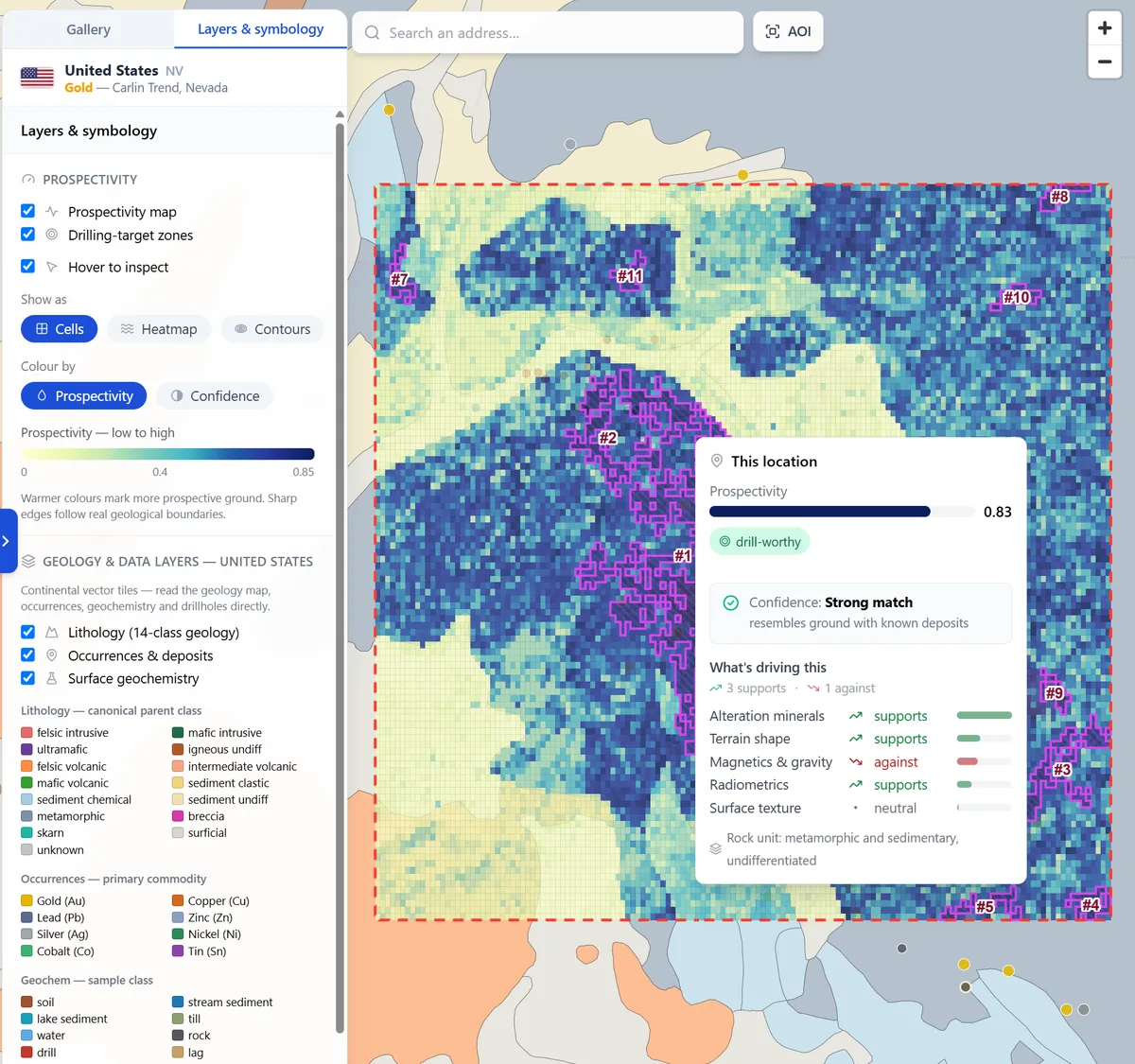
A score across the ground, the evidence behind it and a flag where the model is extrapolating; in Australia, the United States and Canada, a calibrated probability and ranked targets.
Carlin Trend, Nevada: gold prospectivity with ranked targets and the evidence behind a selected location.





























Data published by 80 organisations ·Names and logos belong to their owners; no endorsement or partnership is implied. All 80 sources
The problem
A heatmap you cannot argue with is a heatmap you cannot defend.
Most targeting tools hand you a colour and ask you to trust it. Every target we rank comes with the evidence behind it and an analogue-support signal, so you can explain the call to a board or a partner, and see where a few field samples would sharpen it.
- 51
- Minerals
- In the prospectivity catalogue
- 3
- Certified countries
- Australia, the United States and Canada, with ranked targets
- 44
- Worldwide
- Minerals the global model runs anywhere else on Earth
- 13.8M
- Training samples
- Soil, sediment and rock samples the national models learned from
What a model reads
The evidence behind a target, line by line.
Each target's reasoning is laid out line by line, so your geologist can see which evidence carried it and which argued against it.
Geology and age
Mapped lithology and stratigraphic age, the host-rock question.
Gravity and magnetics
Survey grids that see structure and intrusions beneath cover.
Radiometrics
Potassium, thorium and uranium at the surface, which track rock type and alteration.
Terrain
Elevation, slope and landform, which control where rock is exposed and where it is buried.
Radar
Satellite radar, which reads surface texture through cloud and vegetation.
Spectral alteration
Mineral ratios read from satellite imagery.
What it produces
The output.
Delivered in the MineDSS workspace and as a written report, in formats your GIS and your geologist can both open.
A probability, not a colour ramp
In Australia, the United States and Canada, the probability that each cell carries anomalous values of the target metal. Elsewhere, a prospectivity map.
The evidence behind every target
Host rock, geophysics, terrain and satellite alteration, and how much each moved the result.
An analogue-support signal
Each cell classed by how closely its evidence resembles the ground the model was trained on.
Ranked targets
In Australia, the United States and Canada, ranked by strength and extent, with a flag where evidence is thin.
Read more: the three analogue-support classes
Every target tells you how closely its evidence matches the ground the model was trained on, so you can see where it stands on firm footing, and where a few field samples would sharpen the call.
Analogue-matched
Its evidence closely matches the ground the model was trained on. The model is on firm footing here.
Partial analogue
Part of its evidence matches the training ground. Weigh the result with that in mind.
Ground-truth priority
Unlike the ground the model was trained on, so the result is an extrapolation. A few field samples are the cheapest way to test it.
Coverage
What we model, and where.
In Australia, the United States and Canada a national model serves each mineral, and a run returns ranked targets. Beyond those three countries, 44 minerals run anywhere on Earth from the same trained evidence, returning the prospectivity map, the geology driving it and a per-cell confidence read.
A mineral is listed for a country only where its model passed our release gates and is live. Models that fail are not used. Next, the models are retrained on the full record and new sources, such as hyperspectral imagery, before we use them to rank and select ground.
Browse all 51 minerals
47
minerals in Australia
Ranked targets included

51
minerals in United States
Ranked targets included

37
minerals in Canada
Ranked targets included
44
minerals anywhere else on Earth
Map, geology, confidence
| Mineral | | | | |
|---|---|---|---|---|
| Antimony | ✓ | ✓ | ✓ | ✓ |
| Barium | ✓ | ✓ | ✓ | ✓ |
| Beryllium | ✓ | ✓ | ✓ | ✓ |
| Bismuth | ✓ | ✓ | ✓ | ✓ |
| Boron | ✓ | ✓ | ✓ | |
| Caesium | ✓ | ✓ | ✓ | ✓ |
| Chromium | ✓ | ✓ | ✓ | ✓ |
| Cobalt | ✓ | ✓ | ✓ | ✓ |
| Copper | ✓ | ✓ | ✓ | ✓ |
| Dysprosium | ✓ | ✓ | ✓ | |
| Europium | ✓ | ✓ | ✓ | |
| Fluorine | ✓ | ✓ | | |
| Gadolinium | ✓ | ✓ | ✓ | |
| Gallium | ✓ | ✓ | ✓ | ✓ |
| Germanium | ✓ | ✓ | ✓ | ✓ |
| Gold | ✓ | ✓ | ✓ | ✓ |
| Hafnium | ✓ | ✓ | ✓ | ✓ |
| Indium | ✓ | ✓ | ✓ | |
| Lanthanum | ✓ | ✓ | ✓ | |
| Lead, zinc & silver | ✓ | ✓ | ✓ | ✓Zinc only |
| Lithium | ✓ | ✓ | ✓ | ✓ |
| Manganese | ✓ | ✓ | | |
| Molybdenum | ✓ | ✓ | ✓ | |
| Neodymium | ✓ | ✓ | ✓ | |
| Nickel & cobalt | ✓ | ✓ | ✓ | ✓Nickel only |
| Niobium | ✓ | ✓ | ✓ | ✓ |
| Palladium | ✓ | ✓ | ✓ | ✓ |
| Phosphate | ✓ | ✓ | | |
| Platinum | ✓ | ✓ | ✓ | ✓ |
| Praseodymium | ✓ | ✓ | ✓ | |
| Rare earths | ✓ | ✓ | ✓ | ✓ |
| Rhenium | ✓ | ✓ | | |
| Rubidium | ✓ | ✓ | ✓ | ✓ |
| Samarium | ✓ | ✓ | ✓ | |
| Scandium | ✓ | ✓ | ✓ | ✓ |
| Selenium | ✓ | ✓ | ✓ | |
| Silver | ✓ | ✓ | ✓ | ✓ |
| Strontium | ✓ | ✓ | ✓ | ✓ |
| Tantalum | ✓ | ✓ | ✓ | |
| Tellurium | ✓ | ✓ | ✓ | ✓ |
| Terbium | ✓ | ✓ | ✓ | |
| Thorium | ✓ | ✓ | ✓ | ✓ |
| Tin | ✓ | ✓ | ✓ | ✓ |
| Tin & tungsten | ✓ | ✓ | ✓ | |
| Titanium | ✓ | ✓ | | |
| Tungsten | ✓ | ✓ | ✓ | ✓ |
| Uranium | ✓ | ✓ | ✓ | ✓ |
| Vanadium | ✓ | ✓ | ✓ | ✓ |
| Ytterbium | ✓ | ✓ | ✓ | |
| Yttrium | ✓ | ✓ | ✓ | ✓ |
| Zirconium | ✓ | ✓ | ✓ | ✓ |
Live examples
See it on real ground.
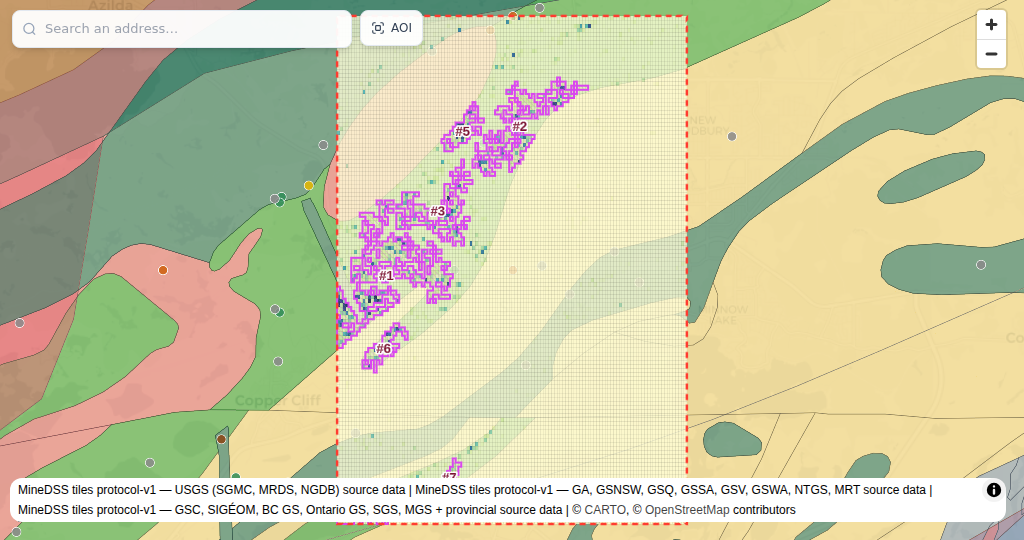
Explore 11 real example runs across Australia, the USA and Canada: the prospectivity map, the per-target reasoning, the geology layers and the analogue-support signal. No login. Click any area to open it live.
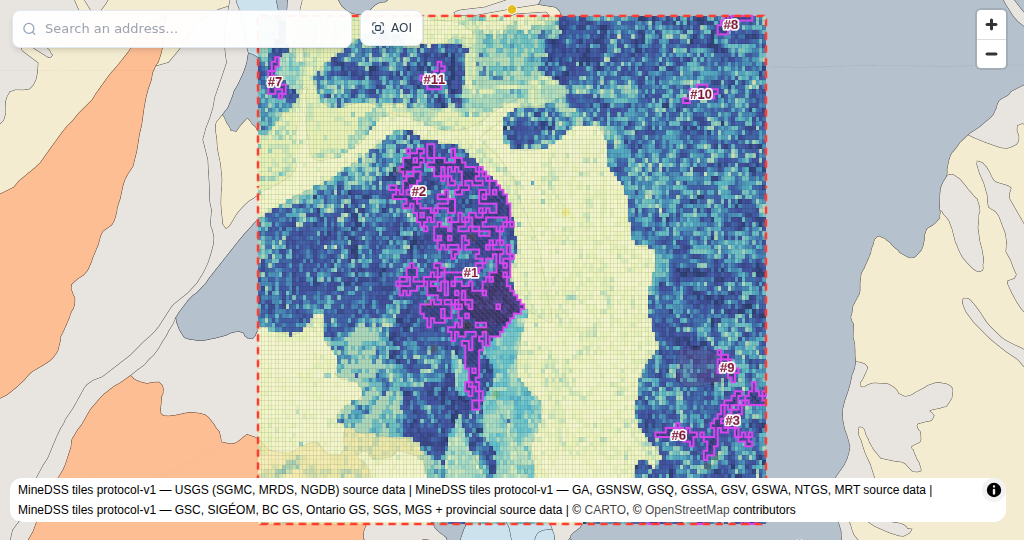 Carlin, NV
  Sudbury, ON
 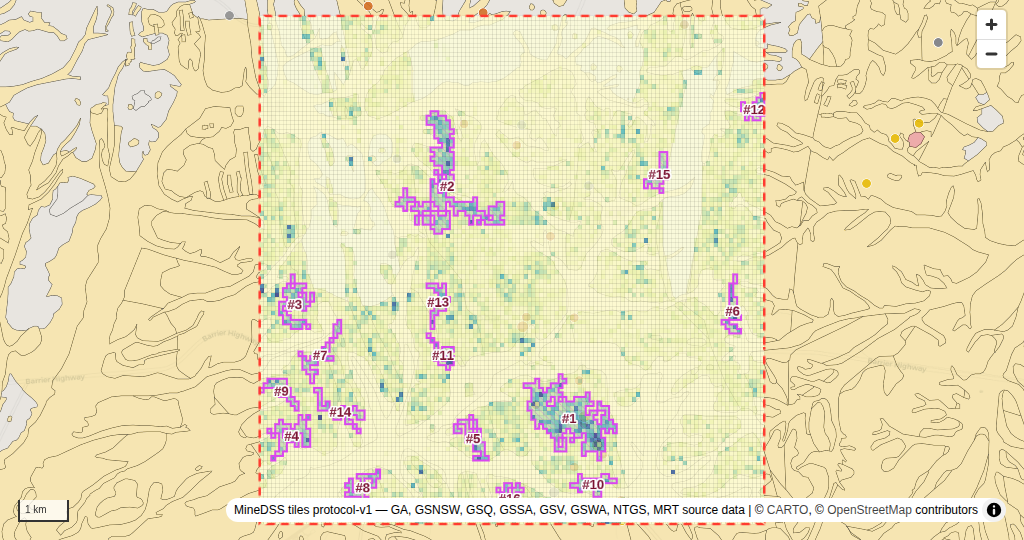 Cobar, NSW
 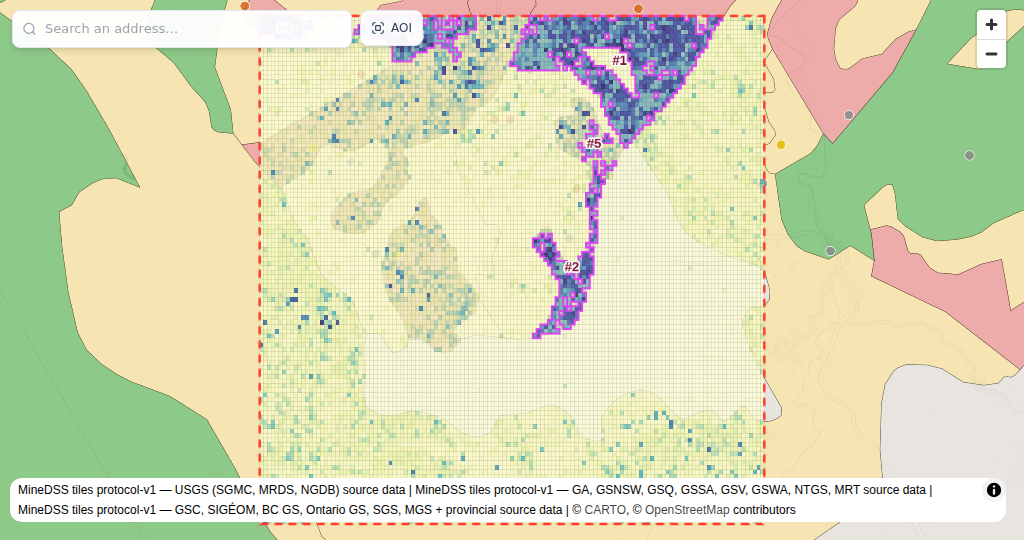 Morenci, AZ
 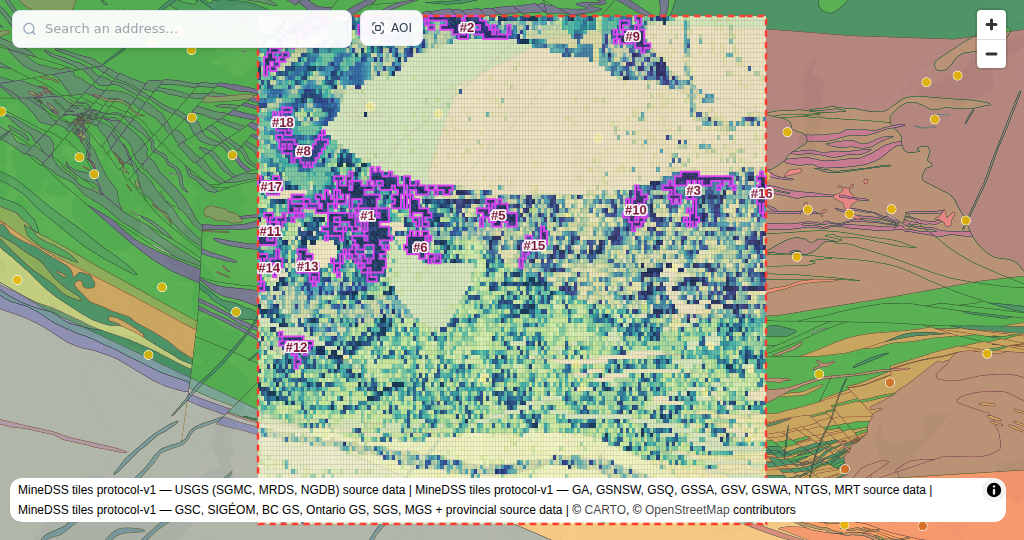 Val-d'Or, QC
 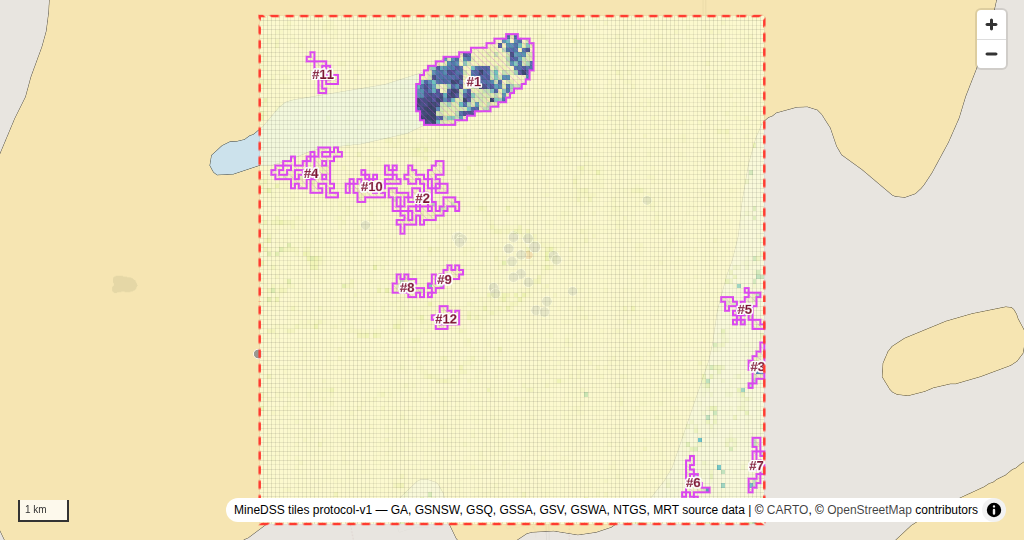 Olympic Dam, SA
 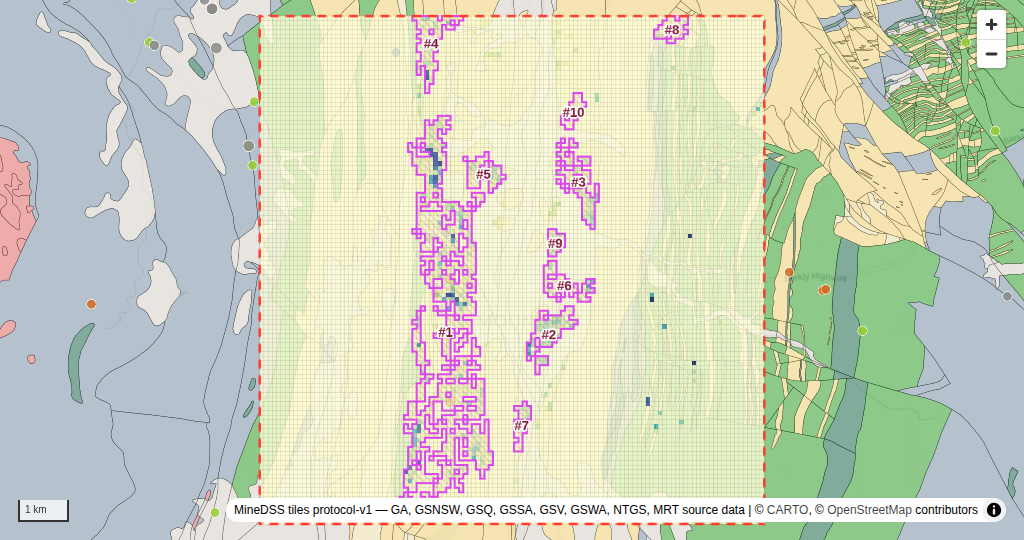 Mount Isa, QLD
 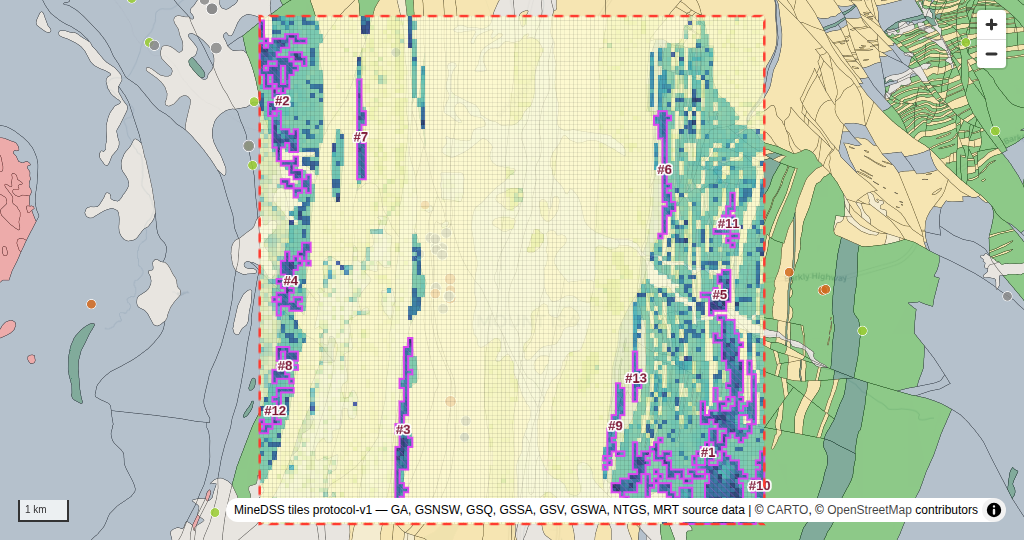 Mount Isa, QLD
 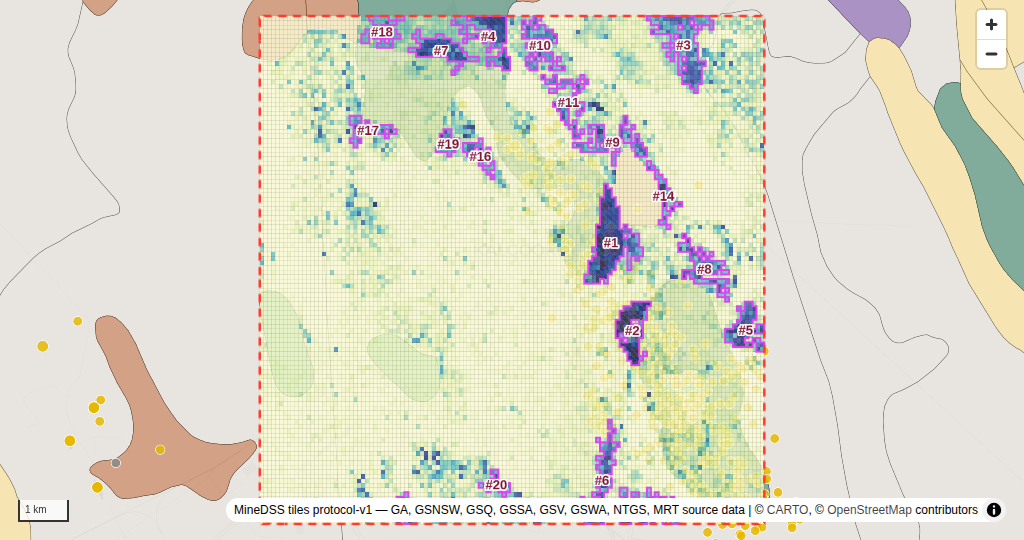 Kalgoorlie, WA
 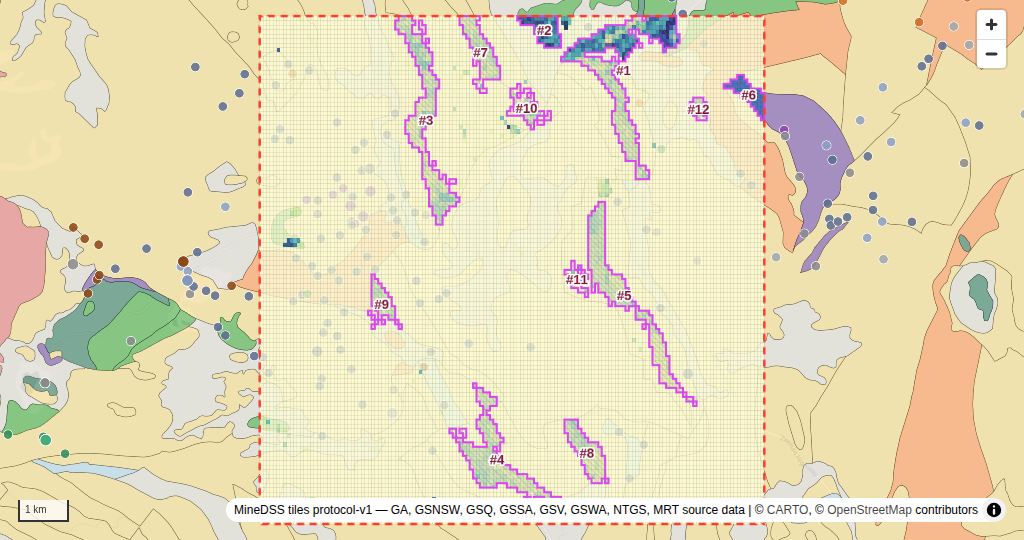 Avebury, TAS
 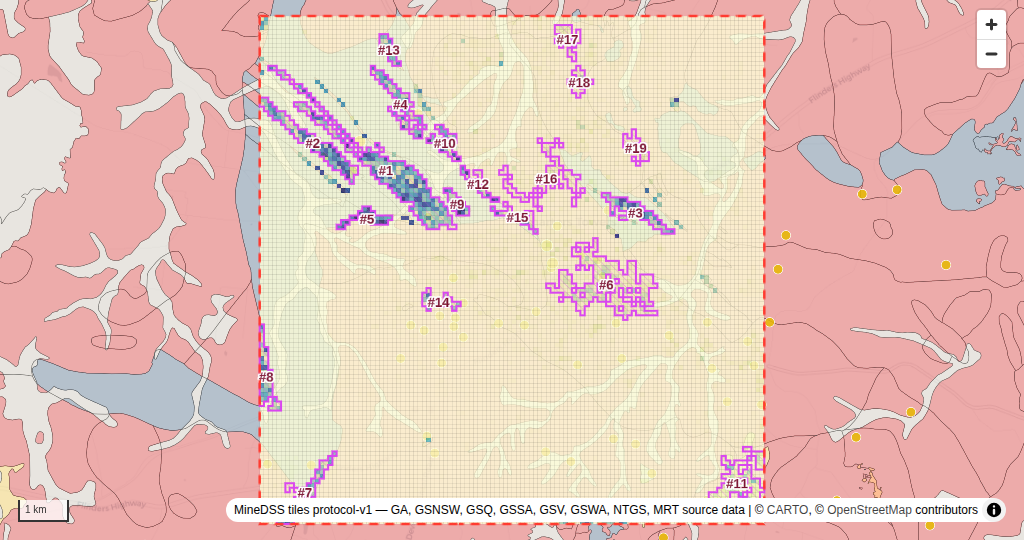 Charters Towers, QLD
 Talk to us
Partners, investors, publishers and researchers.
Real areas across three countries, from ground that closely matches the training data to frontier ground where we would recommend a few field samples first. No login is needed to open any of them.
From a region to your drill holes
Three scales, one evidence base.
The national or global models over a region; field data for a project model; add your drilling for a model in three dimensions.
In service · every mineral in the catalogue
National and global models
Every mineral in the catalogue run on an area: a score across the ground with its evidence, ranked targets in Australia, the United States and Canada, and the global model for 44 minerals everywhere else.
Best for screening a region fast, and for explaining every target to a board or joint-venture partner.
At project scale
Project models from field data
Geochemistry, geophysics and mapping from the ground itself, with our spectral and structural interpretation, integrated into one targeting model for the project. Tested on held-out ground; where the data cannot support a reliable model, we say so.
Used once soil, rock or stream samples, surveys or mapping exist over the ground.
With drilling
Drill-hole and 3D models
Your assays and lithology logs brought into three dimensions with the surface evidence: the continuity of mineralisation between holes, to inform the next phase of drilling.
Best once holes are in the ground and the question is where the system continues.
Project-scale work includes processing and interpreting exploration data: magnetics, radiometrics, and soil, rock and stream geochemistry, alongside the published record we hold.
Talk to usRead more: the four checks every served model passes before release
- 01
The target is never a feature
The commodity being predicted is withheld from the model entirely.
- 02
Geochemical twins are removed
Any element so tightly correlated with the target that prediction would be circular is excluded, so the result is inference from independent chemistry.
- 03
Scored only on unseen ground
Held-out test blocks are separated from the training data, so no score is inflated by nearby training points.
- 04
Regression-gated at release
Every deployment must reproduce frozen reference results exactly before it ships, so the tested model and the served model are provably the same.
Model skill is measured nationally on held-out ground: whole blocks are withheld, and the model must still rank the anomalous samples there above background. It is model-level skill, never a specific site's measured accuracy, and never a discovery or resource claim. A mineral is modelled in a country only where its national model passed our release gates.
Straight talk
What this is, and what it isn't.
We would rather say less than claim more than the evidence supports.
It is
- Relative prospectivity with the evidence shown: decision support for where to explore next
- Tested on ground it never saw: whole blocks withheld from training, kept spatially separate
- Honest about extrapolation: ground unlike anything the model has learned from is flagged, not coloured in
It is not
- A resource or reserve estimate (JORC, NI 43-101)
- A discovery claim: the drill confirms
- Drilling or investment advice
- Ranked targets outside Australia, the United States and Canada
- A measure of any specific site's accuracy: model skill is measured nationally
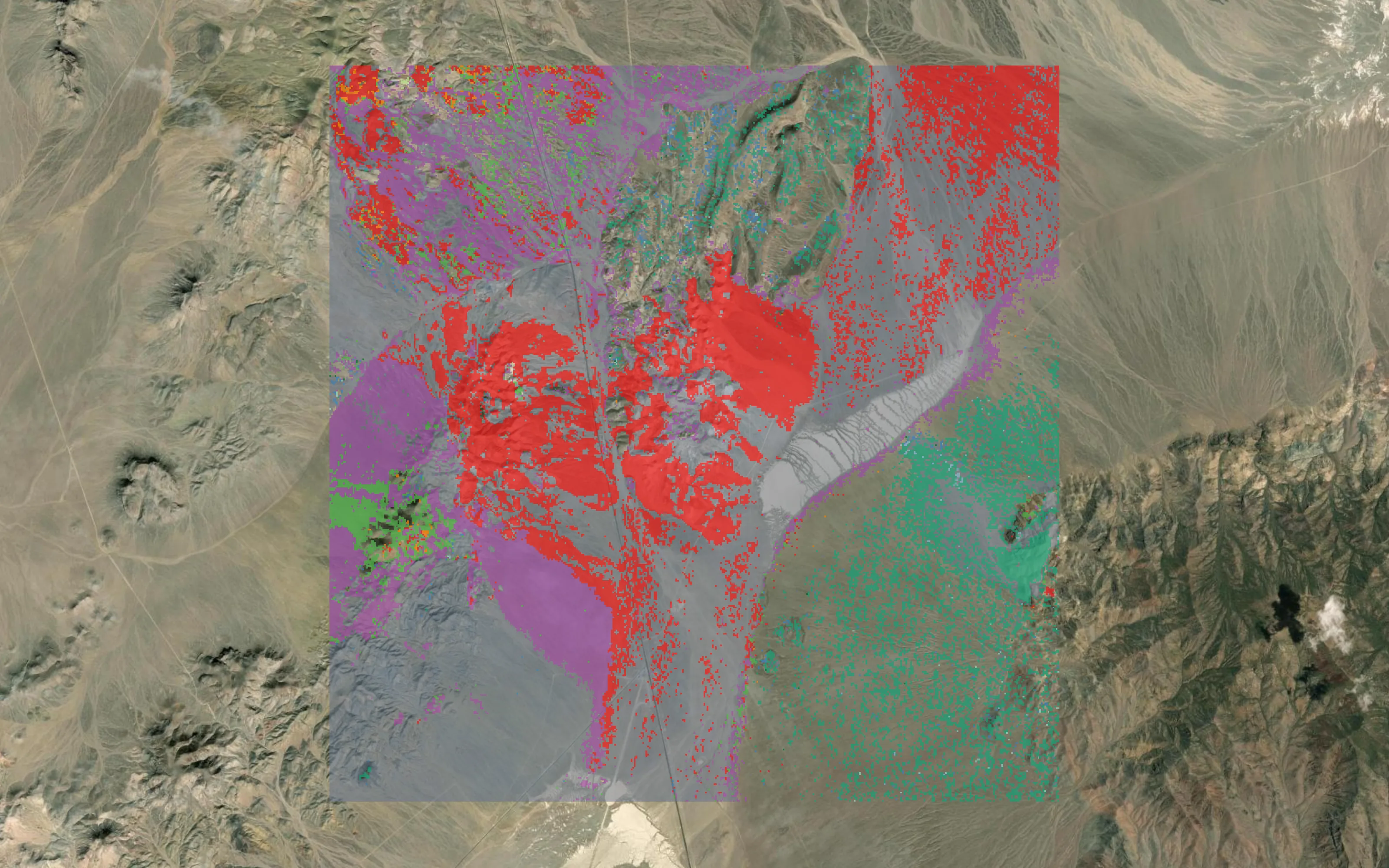
Next in the workflow · 04
Spectral Remote Sensing
What is at surface, and what structures control it?
Continue-
Partners
Exploration and mining companies interested in working with us.
-
Investors
The record, the models and the ground they point to.
-
Publishers and researchers
Geological surveys, universities and programmes whose work the record is built on.
MineDSS ranks prospectivity to help you decide where to explore next. It is not a discovery, not a JORC or NI 43-101 resource or reserve estimate, and not drilling or investment advice.